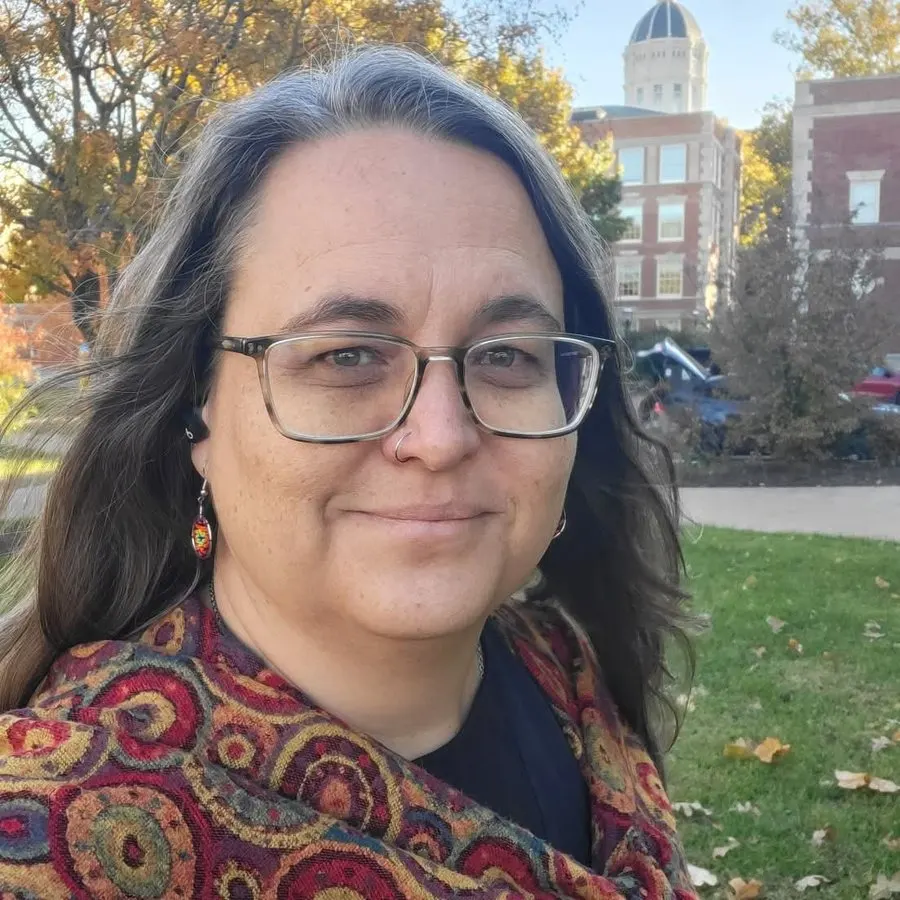
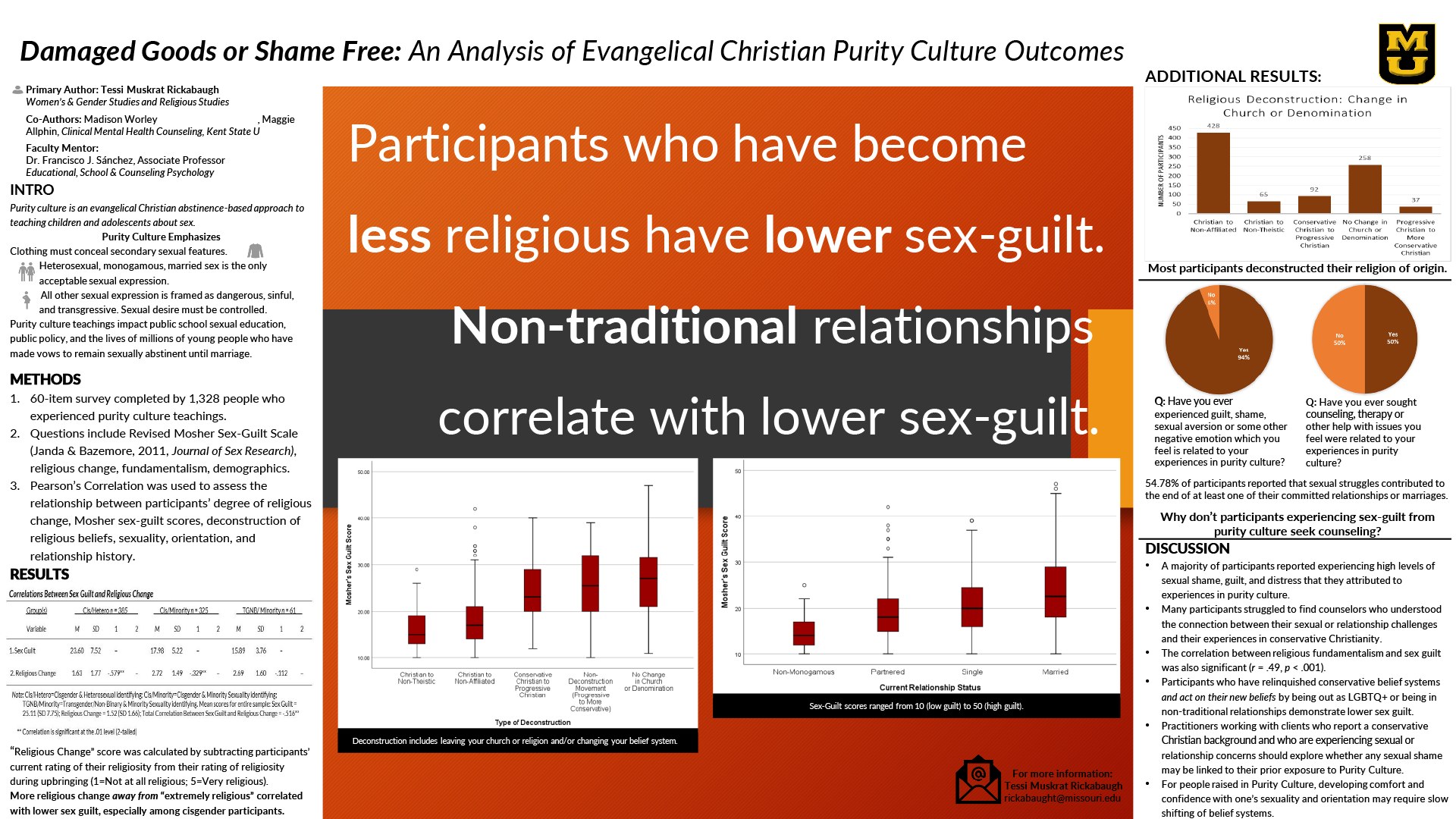
My research centers the voices of people who have experienced religious harm. I study the experience of living within high-control religious systems and the impact of sexual and gender-based harm that takes place in religious contexts. I began my first research project, Purity Culture Outcomes, during the COVID-19 pandemic in 2020. A mixed-method study, my call for participants elicited over 1300 survey responses and over 500 offers for interviews. I ultimately performed 57 in-depth semi-structured interviews and analysis of these data is ongoing. I have published peer-reviewed work on the impact of purity culture on queer women and non-binary people, purity culture as an incomplete rite of passage, and the lived experience of “compassionate” surveillance as a teenager growing up in purity culture in the Midwest.
As an Indigenous scholar and researcher, I apply a critical Indigenous framework to my research and often utilize autoethnographic or other critical qualitative methodologies in my work. I am especially interested in the ways adults achieve empowerment through healing from oppressive systems in religious spaces, and I seek to produce scholarship that will resonate with people who have experienced high-control religion while also providing valuable, empirically sound research useful for clinicians and academics alike.
Peer-reviewed publications
Staton, D. R., Easton, A., Muskrat, T., Lê, D., Trenary, J., & Parmenter, J. G. (2026). “We just see each other”: Relationship experiences among queer, trans, nonbinary, People of Color. Psychology & Sexuality, 1–21. doi.org/10.1080/19419899.2026.2719649
Parmenter, J. G., Easton, A., Lê, D., Staton, D. R., Muskrat, T., Trenary, J., & Abreu, R. L. (2026). “I learned with the community to love who I am”: Queer, transgender, and nonbinary Black, Indigenous, and People of Color’s experiences of resisting and healing from internalized oppression. Journal of Counseling Psychology, 73(4). doi.org/10.1037/cou0000869
Parmenter, J. G., Lê, D., Barrita, A. M., Easton, A., Muskrat, T., Staton, D. R., & Trenary, J. (2026). “I think I take on the whole system”: Experiences of intersectional proximal minority stress among queer, transgender, and nonbinary People of Color. Cultural Diversity & Ethnic Minority Psychology. Advance online publication. doi.org/10.1037/cdp0000789
Lê, D., Muskrat, T., Staton, D. R., Easton, A., Trenary, J., & Parmenter, J. G. (in press). “If this is the water that you are wading in, how do you learn to surf?”: Experiences of religion and spirituality among LGBTQ+ Black, Indigenous, and People of Color. The Counseling Psychologist.
Muskrat, T. Y., Porcaro, A. K., Worley, M. G., Franco, A. E., Parmenter, J. G., & Sánchez, F. J. (2025). “Being yourself is a sin”: The impact of evangelical Christian purity culture on sexual and gender minority people socialized as women. The Counseling Psychologist, 53(5). doi.org/10.1177/00110000251352578Accepted version (PDF)Supplemental files (PDF)
Muskrat, T. (2023). The space between: Liminal time within purity culture. Theology & Sexuality, 29(2–3), 109–129. tandfonline.comAuthor manuscript (PDF)
Under review
Simpson, N. E., Muskrat, T., & Kowal, E. (2026). Purity culture and health: Mapping the emerging field. Journal of Religion and Health. Under review.
Book chapters
Purity Culture, Bodies, and Beliefs
Muskrat, T. (2026). It’s never enough: Purity culture and surveillance. In V. Houser & M. Ramler (Eds.), Bodies and beliefs: Purity culture and the rhetoric of religious trauma. Penn State University Press.
Muskrat, T. (2025). The space between: Liminal time within purity culture. In K. House & S. Moslener (Eds.), Evangelical purity culture and its discontents (1st ed., pp. 26–46). Routledge, Taylor & Francis Group.
Muskrat, T. (2025). Seeking the sacred in St. Joseph Museums: A basket made by small hands. In S. Cohen & R. Gregory (Eds.), Confluences: Religion, health, and diversity in Missouri (pp. 233–257). University of Missouri Press.
Recent posters
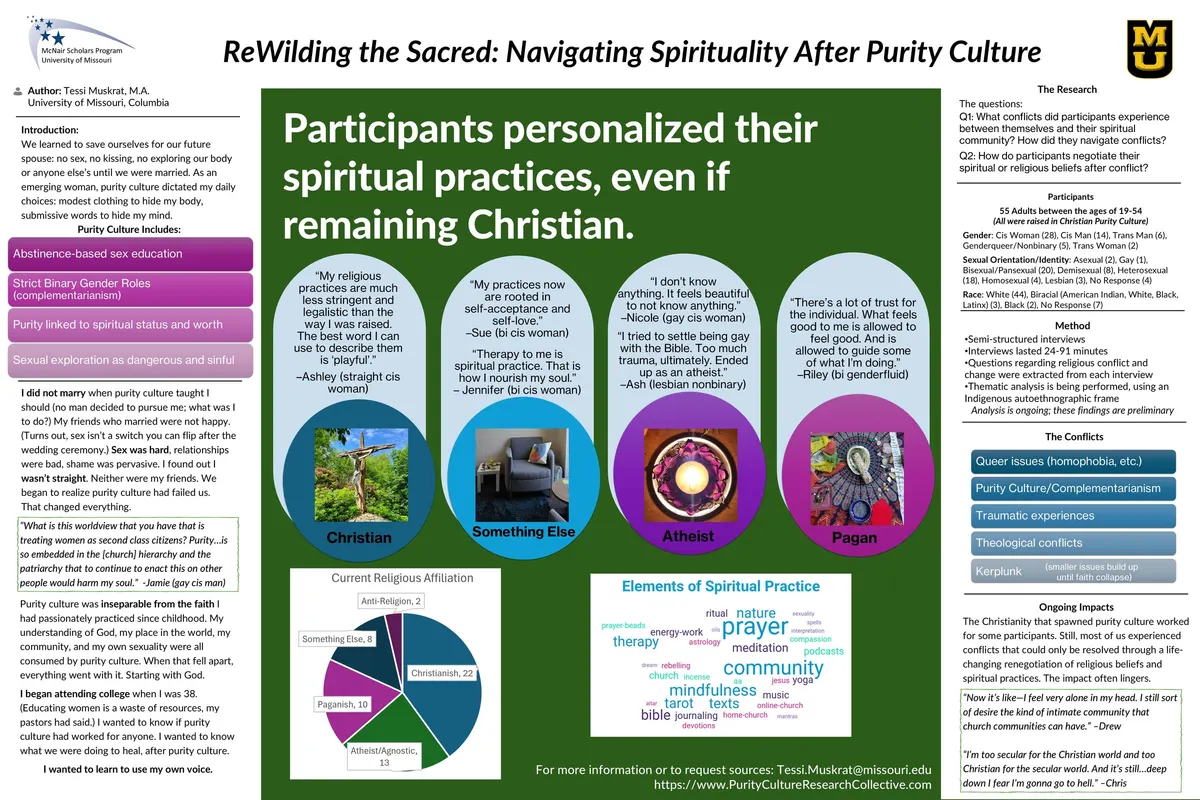
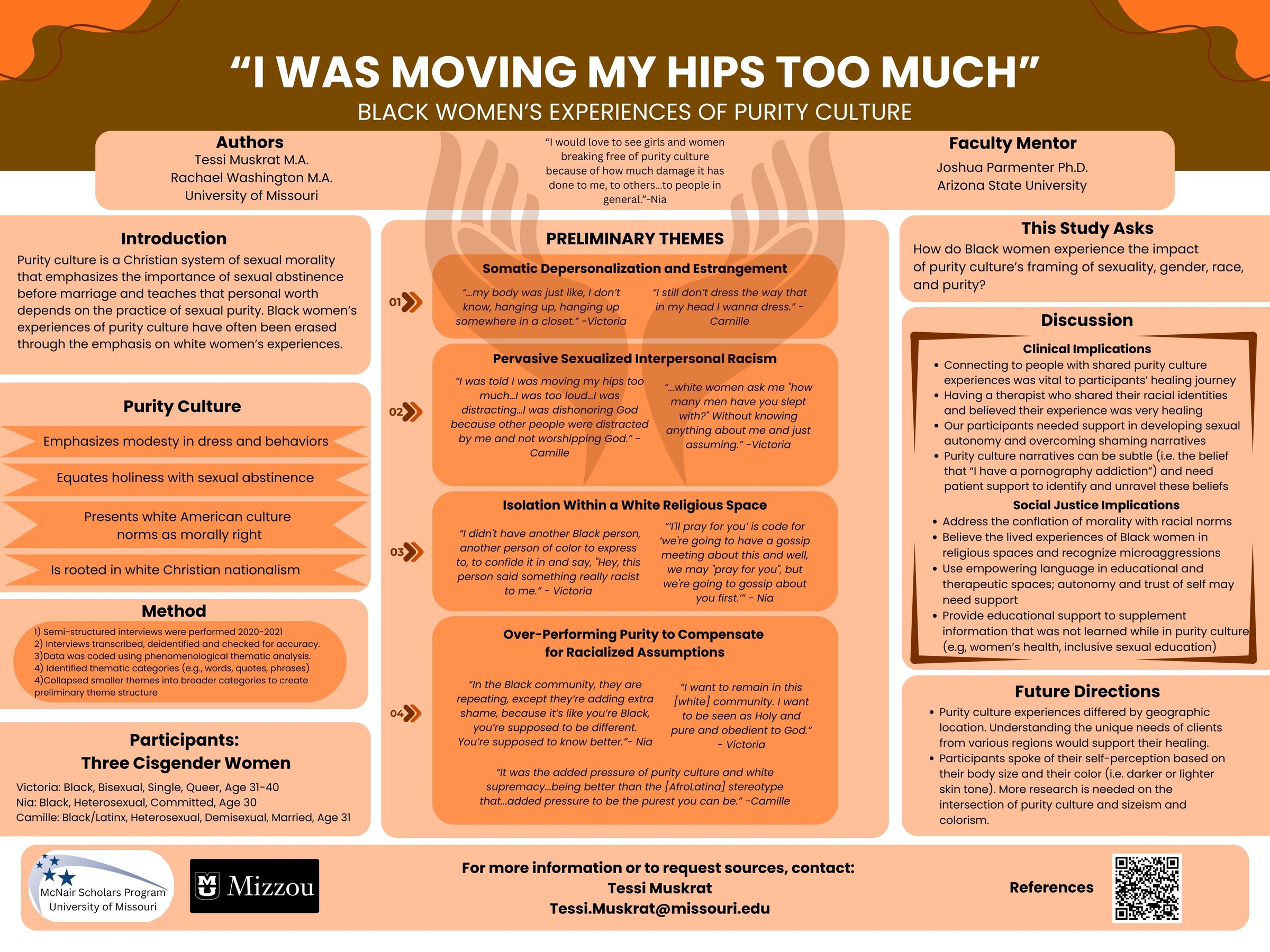
ReWilding the Sacred: Navigating Spirituality After Purity Culture Muskrat, T. (2026, November). Poster presented at the National Women’s Studies Association Conference. Full poster (PDF)“I Was Moving My Hips Too Much”: Black Women’s Experiences of Purity Culture Muskrat, T., Washington, R., & Parmenter, J. G. (2026, January 28–30). Poster presented at the National Multicultural Conference and Summit, Seattle, WA.
Selected presentations
Muskrat, T., & Isaacs, D. (2026, June). Honoring our sacred other: A love story for dissertating while Indigenous. Roundtable, Society of Indian Psychologists Annual Convention, Logan, UT.
Ramler, M., Muskrat, T., Sommer, K., Peace, C., & Lewis, C. (2026, May). Bodies and beliefs: Righteous indignation and religious trauma. Panel, Rhetoric Society of America, Portland, OR.
Miller, N., Muskrat, T., Sánchez, F., & Parmenter, J. G. (2026, August). “If you’re male, women are dangerous”: Purity culture for the AMAB person. Poster, American Psychological Association Convention, Washington, DC.
Miller, N. A., Muskrat, T., Sánchez, F. J., Parmenter, J. G., & Randall, A. K. (2026, July). Purity culture as sexual script: Shaping desire, sexuality, and relationships. Poster, International Association for Relationship Research Conference, Glasgow, Scotland.
Muskrat, T. (2024, August). Impact and empowerment: The experiences of adults raised in purity culture. Symposium, American Psychological Association Convention, Seattle, WA.
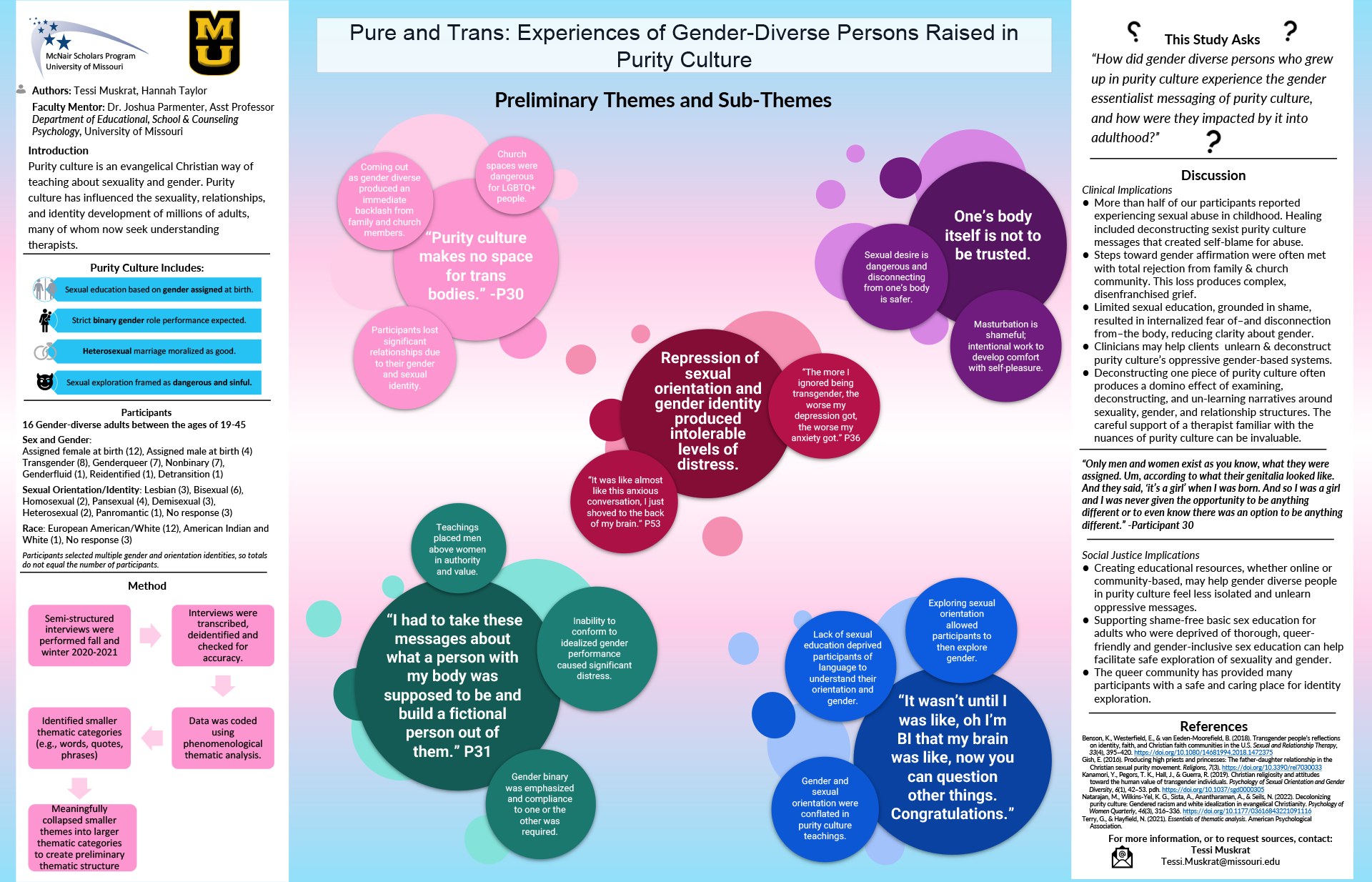
Muskrat, T., & Taylor, H. (2024, January). Pure and trans: Experiences of gender-diverse persons raised in purity culture. Poster, National Multicultural Conference and Summit, Santa Fe, NM.
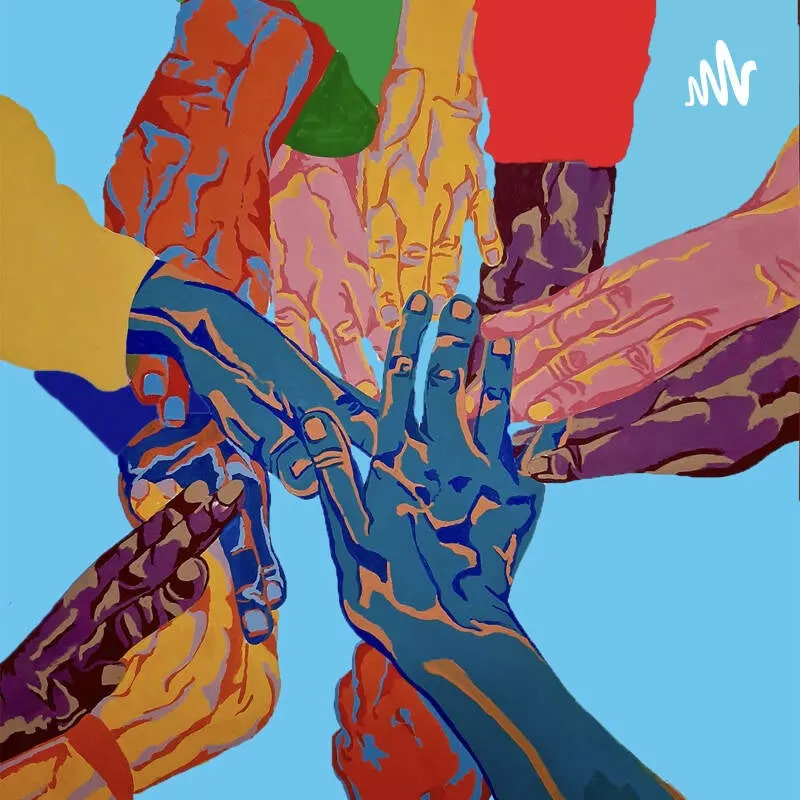
Tessi was featured on an episode of Pure to Pieces, a podcast that involves "sitting down with other artists, recovering christians, activists, psychologists, doctors, & friends to explore what we have been taught, how our identities have shifted, and how we will move forward" in light of purity culture's effect.
Paper presentation · October 2021
The Space Between (SSSR Annual Meeting)
Society for the Scientific Study of Religion. Uses liminality theory to examine the outcomes of purity culture. Captioned.
Poster presentation · August 2021
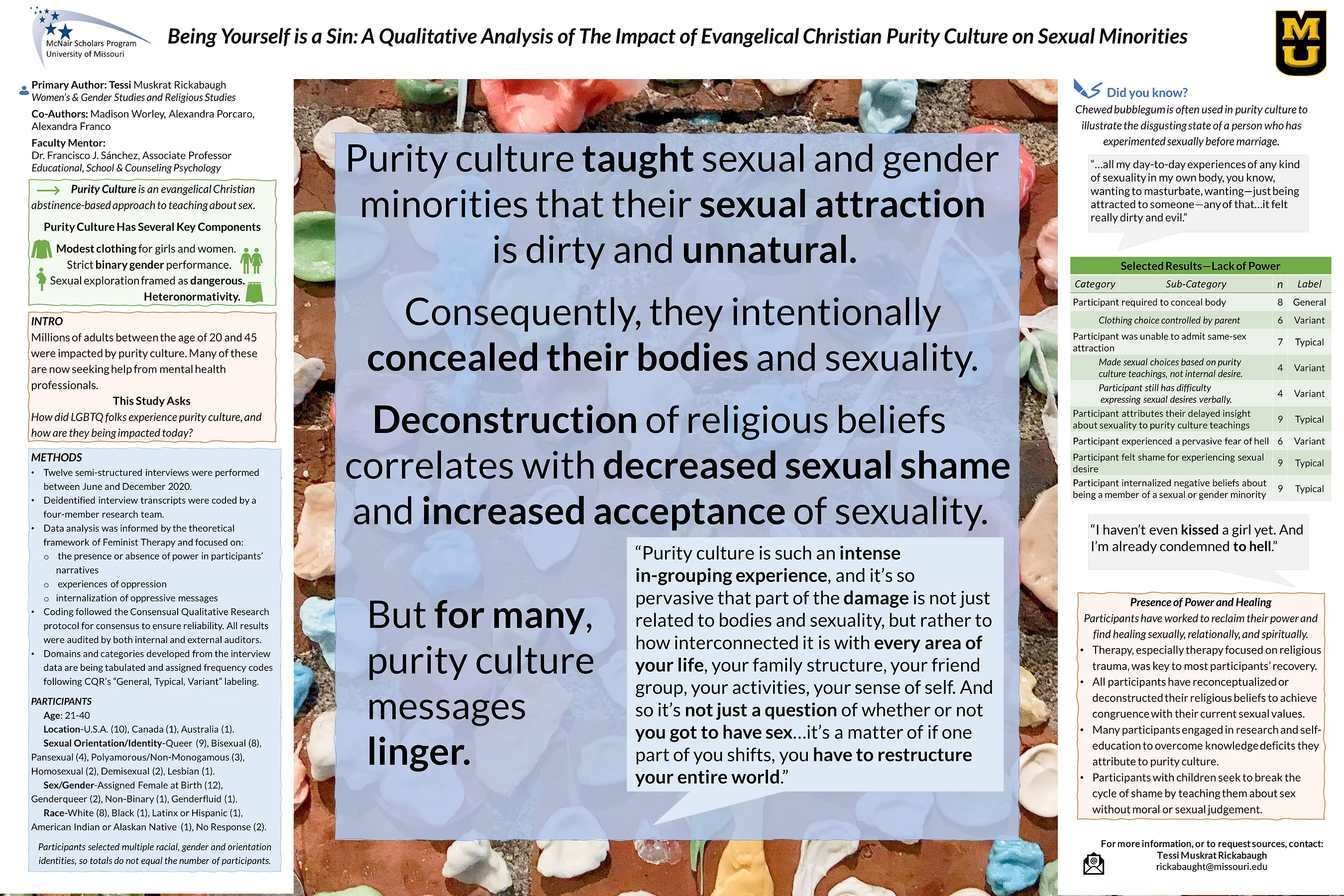
Being Yourself is a Sin (APA Convention)
Initial results from the first set of Purity Culture Outcomes interviews. Captioned.
In addition to my current projects, I often collaborate with other researchers on topics related to purity culture, religious harm, queerness and sexuality, and healing religious harm. To learn more about my research or to propose a collaboration, please email Tessi@TheBarefootJourney.com.